AI workforce strategy TL;DR
AI adoption is not limited to just a technology initiative. More importantly, it is a workforce readiness initiative.
For leaders, the biggest AI adoption challenges often appear outside the tool itself: unclear use cases, fragmented data, workflow disruption, skill gaps, governance questions, and limited operating discipline.
A strong AI workforce strategy connects technology decisions to business outcomes, workforce transformation, governance, and the people who will use AI in day-to-day work.
The organizations that gain the most value from AI will be the ones that prepare their workforce as carefully as they prepare their technology.
Many organizations believe the hardest part of AI adoption is choosing the right technology. In reality, the bigger challenge may be preparing the workforce that will use it.
AI has moved quickly from experimentation to enterprise investment. Leaders are evaluating how to improve productivity, accelerate decision-making, streamline operations, enhance customer and employee experiences, and create new forms of business value. But as BCforward’s AI Governance in Action whitepaper notes, the question is no longer whether AI matters, but rather how to adopt it in a way that is scalable, responsible, and aligned to the business.
That is where an AI workforce strategy becomes essential.
The tool may be powerful. The use case may be compelling. The business case may be clear. But if teams do not understand how AI changes their work, where human judgment remains required, what data can be trusted, or who owns the outcome, adoption can stall before value is realized.
An AI implementation strategy cannot stop at deployment. It has to account for people, processes, governance, and execution.
Why AI Is a Workforce Strategy Conversation
AI changes workflows. It can automate tasks, accelerate analysis, surface recommendations, generate content, and reshape how work moves between teams. That means leaders need to look beyond the technology itself and ask how AI will fit into existing operating models.
AI also changes decision-making. When AI supports analysis, prioritization, screening, forecasting, or customer-facing communication, leaders need clarity on where AI informs decisions and where people remain accountable. AI can shape business decisions, influence people-related outcomes, handle sensitive data, and affect enterprise credibility, which means governance cannot be delegated solely to technical teams once adoption begins.
AI changes skill requirements, too. Teams may need AI literacy, data literacy, process redesign capabilities, governance awareness, and greater comfort with working within AI-enabled workflows. This is not only a training issue. It is a workforce transformation issue.
As Joe David, Vice President of Professional Services at BCforward, puts it:
“AI has become more than a technology initiative. It has become a core business capability.”
That distinction matters.
In many organizations, AI appears in strategy decks before it appears in operating models. Leaders may know where they want AI to create value, but the workforce implications are still underdeveloped.
AI transformation is ultimately a people transformation.
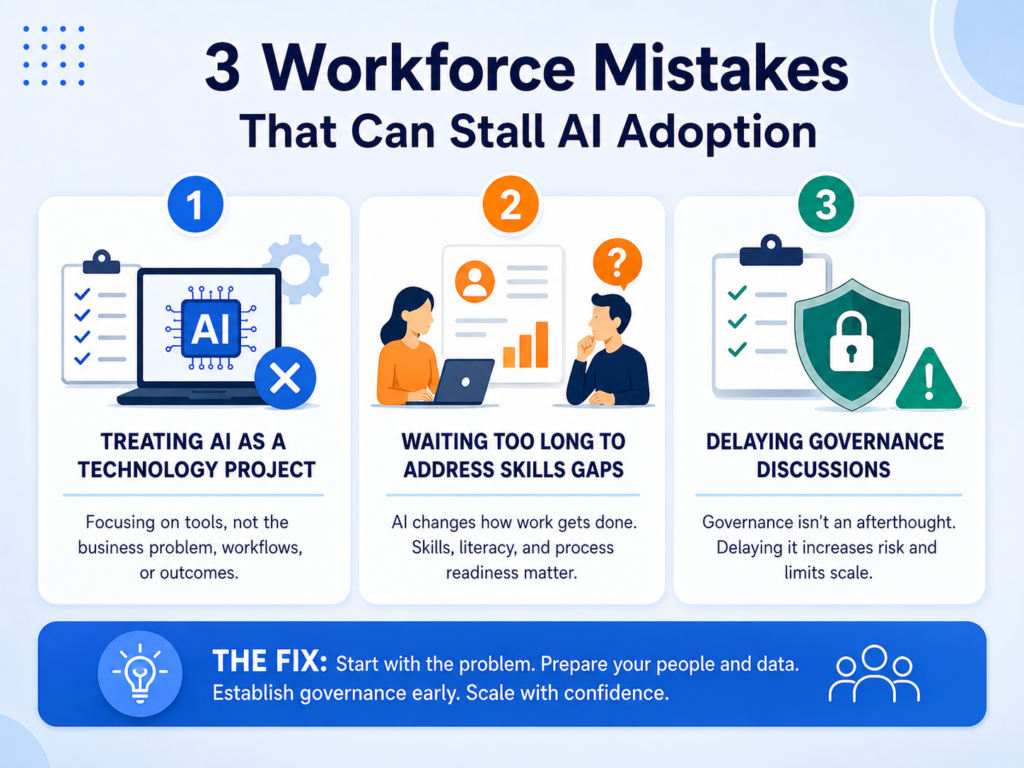
Three Workforce Mistakes That Can Stall AI Adoption
AI initiatives rarely fail because leaders lack ambition. They stall when the organization is not ready to turn ambition into repeatable execution.
Mistake #1: Treating AI as a Technology Project
The first mistake is treating AI primarily as a tool selection exercise.Tool selection matters, but it is often the easier part. The harder work is defining the business problem, understanding the process, preparing the data, identifying the right talent, and determining how success will be measured.
The AI Governance in Action whitepaper warns that AI governance is often misunderstood as a compliance exercise, when in reality it connects strategy to execution. Governance helps ensure:
- Use cases are selected intentionally
- Risks are reviewed before deployment
- Ownership is clear
- Performance is monitored after implementation
Without that structure, AI can become fragmented experimentation.One team pilots a tool. Another builds a use case. A third starts using an AI-enabled platform without central visibility. Each effort may be well-intentioned, but the enterprise lacks a common operating model.
That creates duplicated effort, inconsistent standards, and difficulty scaling what works.Mistake #2: Waiting Too Long to Address Skills Gaps
The second mistake is assuming workforce readiness can wait until after implementation. It cannot.
AI changes the skills required to perform, supervise, improve, and govern work. Leaders need to understand where gaps exist before AI is scaled.
That includes AI literacy: do teams understand what AI is doing, what it is not doing, and where its limitations are?
It includes data literacy: do teams understand the quality, source, and appropriate use of the data behind AI-enabled outputs?
It also includes process redesign: do leaders understand how workflows need to change so that AI can support real outcomes rather than simply adding another layer of complexity?
Change management and workforce readiness are pillars of effective AI governance. AI implementation is an organizational change event, not simply a technology rollout, and governance should address communication, training, role definition, process redesign, and reinforcement.
That is the workforce side of AI readiness. If teams are not prepared, even a strong tool can underperform.Mistake #3: Delaying Governance Discussions
The third mistake is treating governance as something to address after the pilot – an approach that creates risk.
AI can introduce security concerns, compliance considerations, privacy exposure, reputational risk, workforce disruption, and decision-making challenges. The longer governance waits, the harder it becomes to align the organization around responsible use.
Governance is not a one-time approval exercise. It is an ongoing operating discipline.
That discipline includes defining ownership, reviewing risk, classifying use cases, validating data readiness, setting expectations for human oversight, and monitoring performance after deployment.
Governance should not slow AI adoption for the sake of control. Done well, it allows organizations to move faster with more confidence.
AI Readiness Checklist
Before scaling an AI initiative, leaders should be able to answer these questions:
What business problem are we solving?
AI should be tied to measurable business value, not experimentation for its own sake.
Do we have trusted, accessible data?
AI amplifies the quality of its inputs. Fragmented or inconsistent data can accelerate poor outcomes.
Where does this fit in existing workflows?
AI needs to support how work gets done, not sit outside the operating model.
What skills do our teams need?
AI readiness may require AI literacy, data literacy, change management, and process redesign capabilities.
Who owns the outcome and governs the risk?
Accountability should be clear before deployment and remain clear after launch.
Where is human review required?
Leaders need to define where human judgment remains essential.
Can this scale beyond the pilot?
If an AI initiative cannot be explained, owned, and monitored, it is not ready to scale.
What Workforce-Ready Organizations Do Differently
Workforce-ready organizations approach AI differently. They do not start with the question, “Which tool should we buy?” They start with: “What business problem are we solving, and what needs to change across our workforce, workflows, data, and governance model to solve it well?”
That shift is important.
Workforce-ready organizations align AI use cases to measurable outcomes. They understand where AI can create value and where it may introduce risk. They identify capability gaps early. They prepare teams for workflow changes. They define governance before AI is scaled. And they create feedback loops that enable adoption to improve over time.
They also understand that AI readiness is not static. AI systems evolve. Business needs change. Data shifts. User behavior changes. New risks emerge. That is why the whitepaper emphasizes monitoring, transparency, and continuous improvement as a core pillar of effective governance.
The organizations best positioned for the future of work and AI will be those that treat readiness as an ongoing leadership discipline.
What Better Workforce Management Looks Like
As AI becomes more embedded in enterprise work, workforce management must mature alongside it. That starts with better intake processes.
Before launching an AI-enabled initiative, leaders need to define the business problem, expected value, required skills, data dependencies, workflow impact, and governance requirements. Intake should help separate high-value use cases from disconnected experiments.
It also requires clear delivery metrics. AI initiatives should be measured by business impact, not activity alone. Leaders need visibility into whether AI is improving productivity, reducing friction, accelerating decisions, improving quality, or supporting better customer and employee experiences.
Strong consultant support also matters. Many organizations will rely on outside expertise to help design, implement, govern, or scale AI-enabled work. Those consultants need clear expectations, access to the right stakeholders, strong onboarding, and alignment with the broader transformation goal.
Workforce planning alignment is essential. AI may change which skills are needed, where capacity is required, and how teams are structured. Workforce leaders, technology leaders, and transformation leaders need to plan together, not in parallel.
Technology-enabled visibility also becomes more important. Leaders need a clear view of where AI is being used, which initiatives are progressing, where risks exist, and how adoption is affecting work.
Finally, organizations need scalable workforce operations. AI pilots may start small, but enterprise value depends on repeatable execution. That means clear ownership, defined processes, governance checkpoints, and the ability to scale talent and delivery models as AI adoption grows.
AI Readiness Bridges Strategy and Execution
BCforward believes the AI workforce strategy is where AI ambition becomes operational reality.
As a global workforce solutions and consulting firm, BCforward helps organizations bridge the gap between strategy and execution through a unified model of talent, technology, and advisory.
That matters because AI adoption is not only about identifying promising use cases. It is about preparing the organization to execute them responsibly and at scale.
The workforce side of AI includes skills, workflows, governance, delivery support, consultant expertise, adoption planning, and continuous improvement. When those pieces are aligned, organizations are better positioned to move from isolated pilots to durable business value.
When they are not aligned, AI can scale faster than the workforce is prepared to support.
The biggest risk is not moving too slowly with AI. It is scaling AI faster than your workforce is prepared to support it.
The organizations that gain the most value from AI will be the ones that prepare their people as carefully as they prepare their technology.
That means defining the business problem before choosing the tool. Preparing data before expecting reliable outputs. Addressing skills before adoption stalls. Establishing governance before risk escalates. And building workforce models that can support AI-enabled execution over time.
AI is changing how work gets done. The leaders who succeed will be those who treat AI readiness as a workforce-strategy conversation from the start.
Ready to Strengthen Your AI Readiness?
Download the AI Governance in Action Whitepaper to explore a practical executive framework for responsible AI investment.
Talk with a BCforward AI Readiness Expert to discuss how your organization can align workforce strategy, governance, and execution for AI-enabled transformation.