
For the past year, headlines have painted a familiar picture: staffing is slowing, hiring is uncertain, and businesses are pulling back.
But that narrative misses the bigger truth.
The staffing market isn’t contracting. It’s reallocating.
Demand is moving away from legacy transactional staffing models and toward more specialized, technology-enabled, globally integrated workforce solutions. For companies navigating cost pressure and delivery complexity, and for consultants evaluating where long-term opportunity exists, understanding this shift is essential.
We believe the future of staffing industry growth belongs to firms that can unify talent, solutions, and delivery, not just fill roles.
What the Data Actually Says
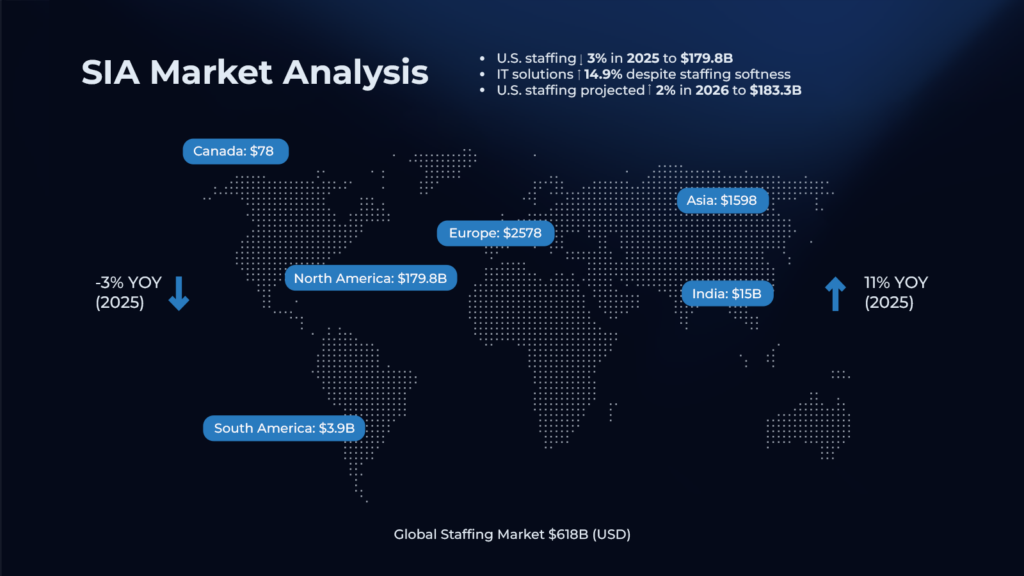
Staffing Industry Analysts (SIA) projected that the U.S. staffing market would decline approximately 3% in 2025, with recovery returning in 2026 as the market rebounds toward $183.3 billion.
Now, in 2026, that forecast tells an important story:
The slowdown was not the start of industry decline. It was a market correction that accelerated broader transformation already underway.
Looking back, the most important signals were never about shrinkage alone:
- IT solutions expanded 14.9% despite staffing softness
- Global staffing remained a $618 billion market
- Demand shifted toward higher-value delivery models
- Recovery trends reinforced long-term resilience
The takeaway for business leaders today is clear: The staffing market isn’t disappearing. It’s evolving.
Traditional staffing segments experienced pressure, but adjacent categories like managed services, consulting, and specialized workforce delivery continued gaining momentum.
For buyers and consultants alike, 2026 is less about reacting to staffing declines and more about understanding where sustainable growth has moved.
The Four Major Shifts Reshaping Staffing Industry Trends in 2026
1. From Staffing to Solutions
Organizations are increasingly moving beyond simple headcount augmentation.
Instead of asking, “Can you fill this role?” buyers are asking:
- Can you solve this business problem?
- Can you manage outcomes?
- Can you integrate talent with delivery accountability?
This is why solution-based staffing, managed services, and consulting models are gaining momentum.
The future belongs to partners who can combine workforce strategy with execution.
2. From Volume to Precision
The high-volume hiring strategies of the past are giving way to precision-based workforce planning.
In sectors like AI, cloud, cybersecurity, healthcare, and digital transformation, demand remains strong, but focused.
Businesses need:
- Specialized talent pipelines
- Faster time-to-submit
- Better candidate-to-start ratios
- Higher-quality matches
In other words, efficiency alone is no longer enough. Precision is becoming the competitive advantage.
3. From Local to Global Delivery
Global capability is no longer optional.
As organizations balance labor shortages, rising costs, and skill gaps, delivery models are increasingly expanding across geographies.
The rise of:
- Offshore and nearshore teams
- Global managed services
- Distributed consulting models
- Hybrid workforce ecosystems
…is reshaping contingent workforce trends across nearly every industry.
The question is no longer whether companies should globalize workforce delivery. It’s how effectively they can do it.
4. From Transactions to Experience
In today’s market, delivery metrics matter more than ever.
SIA benchmarks suggest leading firms outperform many competitors on:
- Time to first submit
- Submission-to-interview conversion
- Offer acceptance rates
- IT fill ratios
For both clients and consultants, experience has become a defining factor.
The firms that win in 2026 will not simply place talent, they will also deliver consistency, transparency, and measurable outcomes.
What This Means for Businesses
For buyers, the shifting market creates both complexity and opportunity.
Key challenges:
- Hiring strategy uncertainty
- Cost reduction pressure
- Delivery speed expectations
- Confusion between staffing, consulting, and managed services models
Strategic takeaway:
Businesses should evaluate workforce partners based on more than price or speed alone.
The right partner should help organizations:
- Optimize workforce strategy
- Improve delivery performance
- Access specialized talent faster
- Scale globally
- Reduce operational friction
In short, workforce decisions are becoming strategic business decisions.
What This Means for Consultants
For consultants, the shift is equally significant.
While some traditional staffing segments may soften, demand is accelerating in growth sectors tied to:
- AI transformation
- Digital modernization
- Enterprise technology
- Specialized project delivery
- Managed workforce programs
This means career stability increasingly depends on alignment with firms positioned for where demand is growing. Not where it has historically been.
Consultants should prioritize organizations that offer:
- Diverse client ecosystems
- Skill growth opportunities
- Delivery maturity
- Long-term strategic relevance
The future of work isn’t shrinking. It’s becoming more specialized.
BCforward’s Point of View: Built for Where the Market Is Going
BCforward’s approach reflects where the workforce market is headed: combining specialized talent, strategic solutions, and delivery accountability into one integrated model.
As businesses demand more precision and consultants seek stronger long-term alignment, success increasingly depends on partners who can adapt to shifting workforce needs while improving outcomes at scale.
Our priority is helping clients and talent move forward with greater confidence in a market defined by transformation.
Final Thought
The real opportunity in 2026 is not simply responding to staffing market change. It’s positioning for where workforce demand is growing next.
Businesses that modernize their workforce strategies and consultants who align with forward-looking partners will be best positioned to succeed in a market increasingly shaped by specialization, delivery excellence, and global capability.