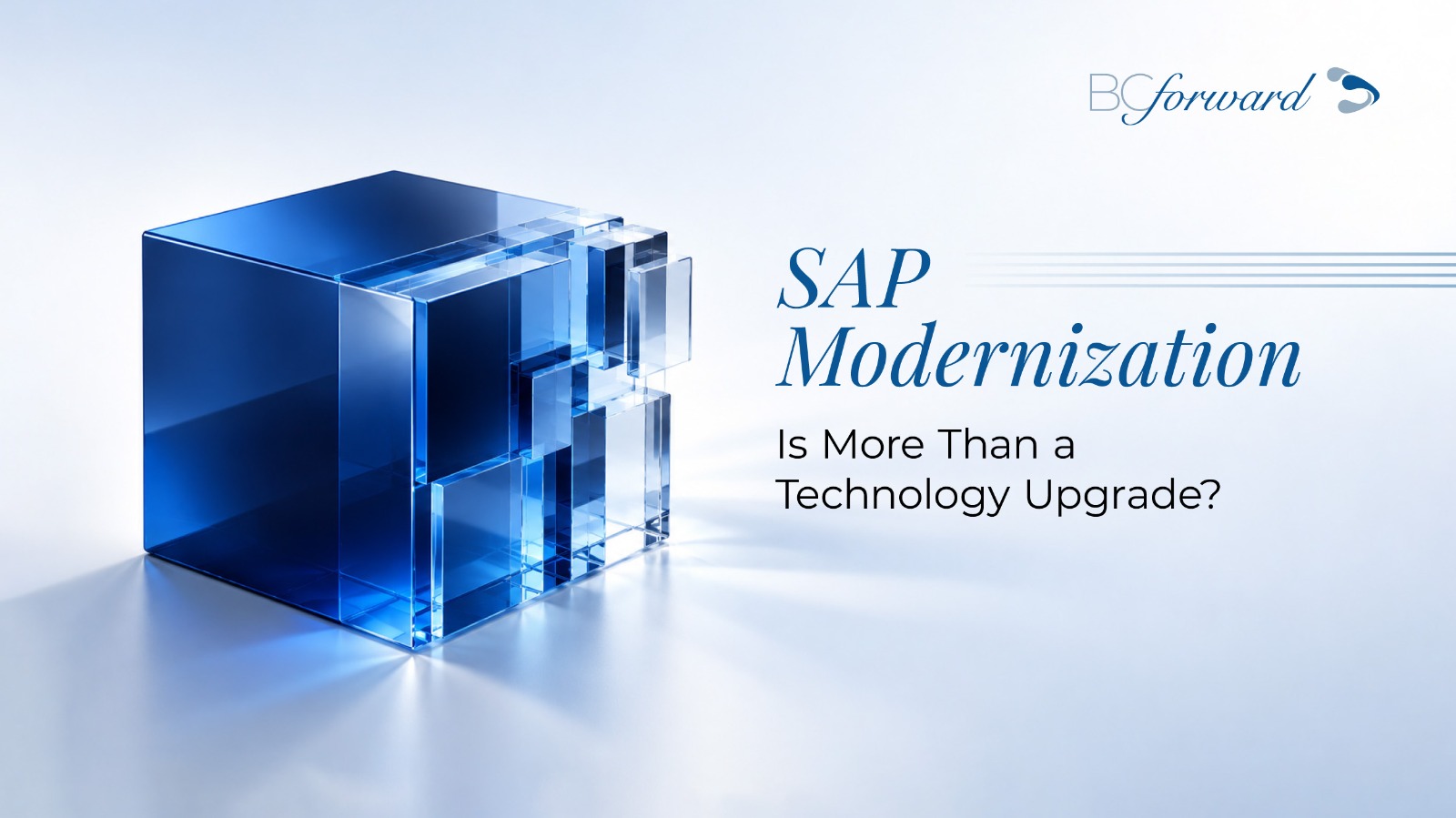
SAP Modernization: Moving Beyond Migration to Measurable Business Value
Enterprise organizations depend on SAP to manage essential business functions, from financial reporting and procurement to supply chain management and operations. But as business demands evolve, many are finding that their legacy SAP environments are increasingly complex, expensive to maintain, and difficult to adapt to new technologies.
With mainstream maintenance for SAP ECC scheduled to end in 2027, modernization is becoming a priority for enterprise leaders. Yet the opportunity extends well beyond meeting a technology deadline. A well-planned SAP transformation can help organizations simplify operations, improve visibility, and establish the foundation for advanced analytics, automation, and AI.
At BCforward, we view SAP modernization as a business transformation opportunity. By connecting strategy, technical execution, and ongoing optimization, we help organizations navigate complex SAP environments while keeping business continuity and measurable outcomes at the center of the process.
TL;DR
- SAP modernization is more than a system upgrade. It provides opportunities to improve operational efficiency, reporting, scalability, and decision-making.
- Preparation is critical. A readiness assessment helps organizations evaluate their SAP environment, understand risks, and establish a practical transformation roadmap.
- The right migration strategy depends on business priorities. Greenfield, Brownfield, and Selective Data Transition approaches serve different organizational needs.
- Modernization creates long-term value. Process optimization, cloud strategy, analytics, and automation can extend the benefits beyond implementation.
- BCforward supports the full transformation journey, from assessment and planning through migration and post-go-live optimization.
Why SAP Modernization Matters Now
Many enterprise SAP environments have evolved over decades, accumulating customizations, integrations, and workarounds to meet changing business requirements. While these systems continue to support essential operations, their complexity can make upgrades more difficult, limit visibility, and increase the resources required for maintenance.
For finance leaders, this may mean lengthy reporting cycles or limited access to timely information. Operations teams may struggle with fragmented processes and inconsistent data, while IT departments devote significant resources to maintaining legacy infrastructure rather than advancing strategic initiatives.
The approaching SAP ECC maintenance deadline adds urgency, but it should not be the sole reason for modernization. Organizations have an opportunity to address long-standing operational challenges while preparing their technology environments for future growth.
Modern SAP environments can help enterprises:
- Improve financial and operational reporting.
- Increase visibility across business functions.
- Reduce legacy complexity and technical debt.
- Standardize processes and improve efficiency.
- Support more scalable technology architectures.
- Establish a stronger foundation for AI and automation.
The challenge is determining how to achieve these benefits without introducing unnecessary cost, operational disruption, or implementation risk.
Three Challenges That Can Complicate SAP Transformation
1. Managing Risk While Maintaining Business Continuity
SAP supports some of an organization’s most critical processes. A disruption to financial systems, procurement activities, or supply chain operations can have consequences well beyond the IT department.
Legacy customizations, complex integrations, inconsistent data, and competing business priorities all introduce risk during modernization. Organizations must understand these dependencies before committing to an implementation approach.
A structured transformation strategy addresses these challenges through early assessment, phased planning, governance, testing, and organizational readiness. The objective is to reduce uncertainty while keeping essential business functions operating throughout the transition.
2. Reducing Complexity Without Recreating Old Problems
Over time, SAP environments often accumulate customizations and process variations that were introduced to solve specific business problems. Some remain valuable, while others create unnecessary complexity or make future upgrades more difficult.
Migrating these processes without evaluating their continued value can carry existing inefficiencies into a modern environment.
SAP modernization creates an opportunity to examine business processes, identify opportunities for standardization, and determine which customizations are truly necessary. Aligning these decisions with operational priorities can help organizations simplify workflows and reduce long-term maintenance requirements.
3. Preparing Data and Processes for AI and Automation
Enterprise leaders increasingly want to incorporate AI and automation into business operations. However, outdated integrations, fragmented data, and inconsistent processes can limit the effectiveness of these initiatives.
Modern SAP environments can improve access to operational data and support more connected business workflows. SAP S/4HANA, for example, provides capabilities for real-time data processing and modern analytics.
Still, a technology upgrade alone does not create AI readiness. Organizations also need reliable data, appropriate governance, integrated processes, and well-defined use cases.
By addressing these foundational requirements during modernization, businesses can position themselves to pursue more advanced capabilities as their needs evolve.
Start With a Clear SAP Transformation Roadmap
One of the most important decisions in an SAP transformation occurs before implementation begins. Organizations need to understand their existing environment, identify business priorities, and determine which modernization approach best supports their objectives.
An SAP Transformation Readiness Assessment provides that starting point. Rather than immediately committing to a large-scale migration, organizations can evaluate their current SAP landscape, technical dependencies, data readiness, and operational requirements.
This assessment helps establish a recommended migration strategy, identify risks, and develop a business case that supports informed investment decisions.
At BCforward, SAP readiness services focus on connecting technical requirements with business goals. The assessment informs a practical roadmap that considers implementation priorities, governance, potential costs, and organizational change.
A clear roadmap also helps stakeholders across IT, finance, and operations establish shared expectations before the transformation moves forward.
Is Your SAP Environment Ready for Modernization?
Understanding your current SAP landscape is the first step toward reducing risk and making informed transformation decisions.
Explore how BCforward can help you assess your environment and build a practical modernization roadmap.
Choosing the Right SAP S/4HANA Migration Strategy
Not every organization needs the same approach to SAP modernization. The appropriate migration strategy depends on existing technology, business requirements, implementation complexity, and the degree of transformation the organization wants to achieve.
Three common approaches include:
Greenfield implementation: Establishes a new SAP environment and creates an opportunity to redesign business processes, simplify configurations, and adopt more standardized workflows. This approach may be appropriate for organizations seeking significant operational transformation.
Brownfield conversion: Converts an existing SAP environment to S/4HANA while retaining much of its current configuration and processes. It may be appropriate for organizations prioritizing continuity while modernizing their underlying technology.
Selective Data Transition: Combines elements of conversion and redesign by allowing organizations to select which data, configurations, and processes move to the future environment. This can be particularly useful for complex global businesses, mergers, acquisitions, or divestitures.
Each approach presents different considerations for cost, implementation effort, process change, and operational risk. A readiness assessment helps determine which path best aligns with the organization’s priorities and long-term strategy.
How BCforward Supports SAP Modernization
BCforward‘s SAP services are designed to support organizations throughout the transformation lifecycle, connecting modernization strategy with implementation expertise and business-focused delivery.
Our approach follows four stages:
Assess: Evaluate the current SAP landscape, business priorities, technical dependencies, and modernization opportunities to establish a clear understanding of the organization’s starting point.
Plan: Develop a transformation roadmap, business case, governance structure, and implementation strategy aligned with business objectives.
Transform: Execute SAP migration and modernization activities, including data migration, system integration, testing, security, and user enablement, with a focus on continuity and risk management.
Optimize: Support post-go-live stabilization, performance improvements, analytics, automation, and ongoing enhancements to help maximize the value of the SAP investment.
Beyond SAP migration, BCforward‘s broader Professional Services capabilities can support related initiatives involving cloud and platform strategy, business process optimization, data and analytics modernization, and AI enablement.
This connected approach helps organizations consider SAP not as an isolated technology project but as part of their broader enterprise transformation strategy.
SAP Modernization in Practice: A Global Manufacturing Example
A global manufacturer operating a heavily customized SAP ECC environment faced the challenge of modernizing its core systems while managing implementation costs and maintaining business operations.
The engagement began with a readiness assessment to evaluate the existing environment and determine the appropriate transformation strategy. Based on those findings, a Brownfield migration approach was recommended and executed.
The reported results included:
- 22% reduction in projected migration costs compared with the organization’s internal estimate.
- 60% improvement in reporting performance following modernization.
The transformation also positioned the organization for future initiatives involving AI, supply chain planning, and automation.
This example demonstrates the potential value of evaluating transformation options before beginning a major implementation. By connecting migration decisions with business priorities, organizations can identify opportunities to manage costs, improve performance, and prepare for future innovation.
Measuring SAP Transformation Success Beyond Go-Live
Completing an SAP migration is an important milestone, but it is not the only measure of success. Organizations should evaluate whether modernization delivers the operational improvements and business value that justified the investment.
Depending on the transformation objectives, meaningful performance indicators may include financial reporting efficiency, system performance, process standardization, data accessibility, user adoption, and reduced technical complexity.
Establishing these measures during planning helps organizations evaluate progress throughout implementation and identify opportunities for continued improvement after go-live.
Modernization also creates a foundation for additional capabilities. Better access to data can support analytics initiatives, standardized processes can create opportunities for automation, and improved technology integration can make future enterprise improvements easier to implement.
This is where an ongoing optimization strategy becomes valuable. Rather than treating SAP modernization as a one-time project, organizations can approach it as a foundation for continuous business improvement.
Turning SAP Modernization Into Long-Term Business Value
SAP modernization presents an opportunity to address current operational challenges while preparing enterprise systems for future business demands.
Realizing that value requires more than choosing a migration approach or implementing new technology. Organizations need a clear understanding of their existing environment, a business-aligned roadmap, disciplined execution, and a plan for continued improvement.
BCforward brings together SAP transformation services and broader Professional Services capabilities to help enterprises assess, plan, transform, and optimize their technology environments.
Whether an organization is beginning to evaluate its SAP S/4HANA transition or looking to improve the performance of an existing investment, the goal remains the same: turn technology modernization into measurable business value.
Build a More Confident SAP Modernization Strategy
From readiness assessments and migration planning to implementation and ongoing optimization, BCforward helps organizations navigate SAP transformation with a focus on business continuity, reduced complexity, and long-term value.
Frequently Asked Questions About SAP Modernization
SAP modernization involves upgrading, migrating, or optimizing an organization’s SAP environment to improve technology performance, business processes, and operational capabilities. It may include moving from SAP ECC to SAP S/4HANA, simplifying customizations, improving data and analytics, and modernizing infrastructure.
Mainstream maintenance for relevant SAP ECC releases is scheduled to end in 2027, creating important support and planning considerations. Modernization also offers opportunities to improve reporting, reduce technical complexity, and prepare for new business capabilities. Certain extended maintenance and transition options may be available depending on the customer’s circumstances.
An SAP Transformation Readiness Assessment evaluates existing SAP systems, technical dependencies, business requirements, and implementation risks. It helps organizations determine an appropriate modernization strategy and develop a roadmap and business case before committing to a larger implementation.
A Greenfield implementation creates a new SAP environment and allows greater flexibility to redesign processes. A Brownfield conversion modernizes an existing environment while preserving more of its current configurations and processes. The appropriate option depends on the organization’s business objectives and technical requirements.
SAP modernization can improve data accessibility, system integration, and process consistency, helping establish the foundation for AI and automation. Successful implementation also requires data governance, clearly defined use cases, and organizational readiness.
BCforward supports SAP readiness assessments, migration and modernization, business process optimization, data and analytics modernization, cloud and platform strategy, and post-go-live optimization. Our approach connects technology decisions with business priorities to help organizations manage transformation risk and achieve measurable outcomes.